


Swing Dancing: As American as Apple Pie

Updated: Aug 28
The remarkable American story of jazz, the Savoy Ballroom, Lindy Hop—and the dance that traveled around the world

Before swing dancing traveled the world, it belonged to America.
Born from the creativity of African American culture, fueled by jazz, and developed on the dance floors of Harlem, swing dancing became one of America's most joyful cultural gifts to the world.
From the legendary Savoy Ballroom to American servicemen carrying Swing overseas, and from Ella Fitzgerald and Count Basie to the dancers who brought Lindy Hop to a new generation decades later, this is the story of a dance that refused to disappear.
And nearly 100 years later, we're still dancing it.
The Savoy Ballroom: Where It Came Alive
1926–2026: Celebrating 100 Years

By the 1920s and '30s, Harlem had become one of America's great centers of music and entertainment. Jazz was evolving—and its syncopation, improvisation, and irresistible rhythms inspired an entirely new way of moving.
Out of this extraordinary culture emerged the Lindy Hop, a social dance built around rhythm, improvisation, individuality, partnership, and joy.
And its most legendary home was the Savoy Ballroom.
Opening in 1926, the Savoy became known as "The Home of Happy Feet." Unlike many venues during an era of segregation, Black and white dancers shared its enormous dance floor.
The greatest orchestras and performers appeared there: Chick Webb, Count Basie, Ella Fitzgerald, Benny Goodman, Duke Ellington, Jimmie Lunceford, and Cab Calloway.
But the musicians were only half the story.
The dancers were creating something, too.
A Laboratory of American Dance

The Savoy wasn't simply a ballroom. It was a laboratory of innovation.
The music influenced the dancers. The dancers influenced the musicians. Dancers challenged one another, improvised, experimented, and created new movements.
Legendary dancers such as Frankie Manning helped develop Lindy Hop into a dance filled with musicality, humor, individuality, athleticism, and extraordinary creativity.
The music asked a question.
The dancers answered it.
SOCIAL DANCE TAKEN TO THE EXTREME
Lindy Hop was—and remains—first and foremost a social dance. But that creativity also produced extraordinary performance dancing.
In the 1941 movie Hellzapoppin', Frankie Manning and members of Whitey's Lindy Hoppers took the dance to astonishing heights with speed, musicality, aerials, and athleticism.
More than 80 years later, it remains one of the most electrifying examples of performance Lindy Hop ever captured on film.
This was what could happen when a social dance born on the floor was taken to the stage.
When the Bands Went to Battle
The Savoy became famous for its legendary Battle of the Bands.
Two orchestras faced one another from opposite bandstands, each trying to out-swing the other while dancers packed the floor.
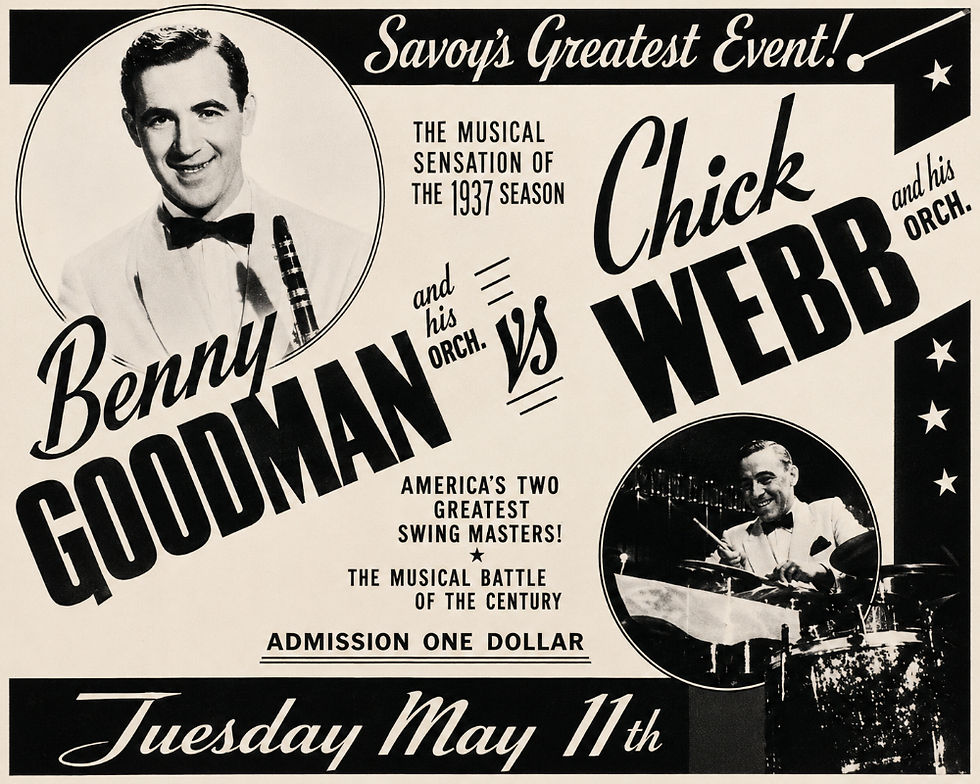
Among the most celebrated were Benny Goodman vs. Chick Webb and Count Basie vs. Chick Webb.
One orchestra answered the other. The musicians pushed harder. The dancers responded.
The dancers weren't simply watching the music—they were part of it.
Ella Fitzgerald and the Sound of the Savoy

The Savoy story is inseparable from Chick Webb and Ella Fitzgerald.
Webb's orchestra became closely associated with the ballroom, and a young Ella emerged as its celebrated vocalist before becoming one of the most recognizable voices in American music.
Places like the Savoy brought musicians, dancers, and audiences together in the same room.
Jazz wasn't background music.
It was something people experienced together.
And they danced to it.
Listen to Ella Fitzgerald with the Chick Webb Orchestra at the Savoy Ballroom around 1938.
The Lindy Hop Goes to War

By the late 1930s, Swing had become a national phenomenon.
Then America went to war.
During World War II, American servicemen and women carried their music, records, dances, and culture around the globe.
From England and France to Australia and the Pacific, communities encountered the rhythms of American jazz and Swing. Songs such as Glenn Miller's "In the Mood" became part of the soundtrack of a generation.
During uncertain times, dance halls offered a few precious hours of music, freedom, normalcy—and joy.
Swing had begun its journey around the world.
The Music Changed. Swing Survived
The Big Band era eventually faded, but American music kept evolving.
Jump blues, rhythm and blues, early rock 'n' roll, Western Swing, rockabilly, and other styles reshaped popular music—and Swing dancing adapted with them.
Because at its heart, Swing was never simply a collection of steps.
It was a way of responding to music:
Playful. Improvisational. Social.
The Swing Revival - Finding the Original Dancers

In the 1980s, something remarkable happened.
Young dancers in Sweden, England, and the United States began rediscovering Lindy Hop through old films and recordings.
But rather than simply reinventing what they saw, they went looking for something far more valuable:
The people who had actually danced it.
Original dancers including Frankie Manning, Al Minns, Norma Miller, and others became teachers and mentors to a new generation.
Technology helped. VHS recorders allowed workshops and historic footage to be watched, studied, and shared across continents.
But the most important connection remained human.
The original dancers passed on not just steps, but music, rhythm, stories, humor, history, and culture.
What could have become a retro dance craze became something deeper—a living connection to the African American dance culture that had flourished at Harlem's Savoy Ballroom.
Lindy Hop wasn't simply recreated.
It was passed on.
America Discovers Swing Again

By the 1990s, Swing suddenly seemed to be everywhere.
Vintage clothing returned. Live bands appeared. Movies, television, and groups such as Big Bad Voodoo Daddy, Royal Crown Revue, Cherry Poppin' Daddies, and The Brian Setzer Orchestra introduced Swing to another generation.
Dance communities sprang up across America—and then around the world.
What had nearly disappeared was thriving again.
From Harlem to the World

Today, Lindy Hop has become an international language.
From Stockholm to Seoul. Shanghai to Sydney. London to Los Angeles.
Dancers gather every weekend to celebrate an American tradition born nearly a century ago. International festivals bring together people from dozens of countries, while new generations of musicians continue discovering Basie, Ellington, Webb, and the music that started it all.
And perhaps the most remarkable part is also the simplest.
Two people who don't speak the same language can walk onto a dance floor together.
One person extends a hand and asks:
"Would you like to dance?"
For a few minutes, two strangers become partners.
They listen. Respond. Improvise.
And very often, they smile.
As American as Apple Pie
Swing dancing reminds us of some of America's greatest strengths.
Born from African American creativity, it crossed cultures, languages, generations, and borders through music and movement.
It celebrates freedom.
It encourages creativity.
It welcomes individuality.
It builds community.
And it has stood the test of time because beneath all the history, fashion, music, and spectacular dancing lies something timeless and deeply human:
The desire to connect.
Perhaps that's why Swing has endured for nearly a century.
Not simply because it's nostalgic.
Not because it's vintage.
But because it still gives us something we need:
A chance to connect, laugh, create, and celebrate together.
Like jazz.
Like baseball.
Like apple pie.
Swing dancing is, and always will be, as American as Apple Pie.
Did Swing Dancing Play a Part in Your Family's Story? Maybe your parents or grandparents danced during the Big Band era. Maybe you discovered Swing during the revival—or perhaps you're discovering it today.
Share this story with someone who remembers when America danced.
The Story Continues

The remarkable thing about Lindy Hop is that its history isn't confined to photographs and old film.
People are still dancing it.
Here in New Braunfels, that history has a personal connection. During the international Swing revival, Rob and Diane van Haaren had the opportunity to learn from and work with several legendary dancers who helped create and shape Lindy Hop. They went on to teach Swing in more than 20 countries before eventually making New Braunfels their home.
Today they continue dancing and sharing what was passed on to them—but they are only one small part of a worldwide community keeping the tradition alive.
Every time a band counts off a Swing tune...
Every time someone walks onto a dance floor for the first time...
Every time someone extends a hand and asks—
"Would you like to dance?"
—the story continues.
Article by Rob van Haaren - info@swingjunction.org
Totally agree with the author, this topic is super relevant right now. Some time ago I came across https://silukr.org and now I often use it as a reference for finding useful information. For related questions, I also occasionally check https://whatiscfdtrading.org/ which is another solid source. Has anyone else used them? What do you think of their content? Personally, it saves me a ton of time.